Company formation in Spain can be an attractive option for both first-time entrepreneurs and established businesses looking to expand into the Spanish or wider European market. However, before starting the registration process, one of the most important decisions is choosing the right business structure.
For most entrepreneurs, the two main options are:
- Autónomo – the Spanish status for self-employed individuals. An Autónomo is not a separate company. Instead, it is an individual who is registered as self-employed and can legally carry out an economic activity in Spain.
- Sociedad Limitada (S.L.) – a Spanish limited liability company and a separate legal entity.
Which option is right for you depends on your type of activity, expected turnover, business risks, whether you will have partners or employees, and your long-term plans.
What Is an Autónomo in Spain?
An Autónomo is a self-employed individual registered to carry out economic activities in Spain. This structure is commonly chosen by people who:
- provide consulting services;
- work as freelancers;
- offer IT or digital services;
- work in creative industries;
- are starting a small business;
- want to test a business idea;
- work independently without business partners or employees.
One of the main advantages of becoming an Autónomo is that the initial process can be simpler than incorporating a company. The entrepreneur needs to complete the relevant tax and social security registrations and choose the appropriate economic activity classification. For foreign entrepreneurs, a NIE number may also be required for various administrative and economic procedures. However, the exact requirements depend on the individual’s circumstances.
What Is a Sociedad Limitada (S.L.)?
A Sociedad Limitada, commonly abbreviated as S.L., is a Spanish limited liability company. It is one of the most common business structures for entrepreneurs who plan to build a company, work with partners, hire employees or operate on a larger scale. An S.L. can be suitable for:
- e-commerce businesses;
- IT companies;
- consulting businesses;
- marketing agencies;
- digital service providers;
- international trading companies;
- start-ups;
- businesses working with international clients.
Unlike an Autónomo, an S.L. has its own legal identity. This makes the structure particularly suitable for entrepreneurs who want to develop a more formal and scalable business.
How Much Capital Is Needed to Establish an S.L. in Spain?
You may still find older information online stating that an S.L. requires €3,000 in share capital. That is no longer the legal minimum. Under the current rules, an S.L. can be incorporated with a minimum share capital of €1. Spanish legislation removed the previous €3,000 minimum and introduced measures intended to make company incorporation faster and more accessible. However, a legal minimum of €1 does not mean that €1 is necessarily enough to operate a business in practice. The appropriate level of capital should be considered in light of the company’s activities, expected expenses, financing needs and overall business model.
How Does Company Formation in Spain Work?
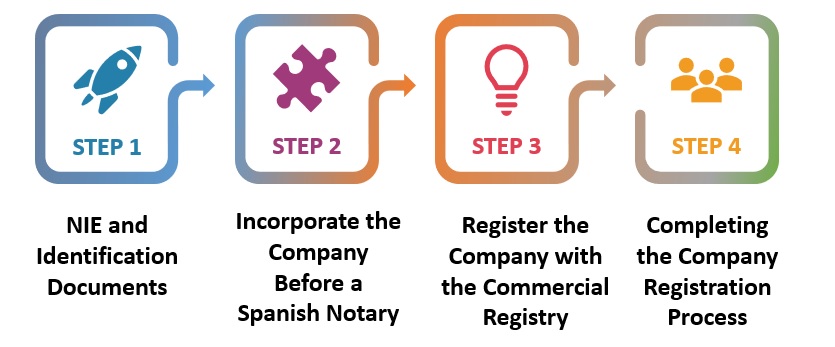
Establishing an S.L. in Spain involves more than simply submitting a registration form. Foreign entrepreneurs may need to prepare identification documents, determine the company’s structure and activity, choose a business name and arrange a registered office before the company can become fully operational. For an international business, it is also worth considering the documents and information you will need after incorporation. Banks, payment providers and foreign business partners may request official company documentation as part of their onboarding and compliance procedures.
- NIE and Identification Documents
For a foreign entrepreneur, one of the first practical considerations is the NIE (Número de Identidad de Extranjero), the identification number assigned to foreigners in Spain. The NIE can be used for various economic and administrative procedures. Whether you need one before incorporating a company depends on your specific circumstances. You should also prepare a valid passport or identity document and any other documentation required for the incorporation process. It is important to remember that an NIE is not a Spanish residence permit and does not, by itself, give you the right to live or work in Spain.
- Choose the Business Structure and Activity
Before incorporating a company, you need to define what the business will actually do. This usually includes determining:
- the company’s main business activity;
- who the shareholders will be;
- who will act as the company administrator;
- where the registered office will be located;
- who the main customers will be;
- whether the business will operate in Spain, elsewhere in the EU or internationally.
This step is particularly important for e-commerce, IT, consulting and other internationally focused businesses, as the legal and tax structure should reflect the actual business model.
- Choose and Reserve the Company Name
The next step is to choose a company name and check its availability. For an S.L., the chosen name must go through the relevant name reservation process before the company can be formally incorporated. Choosing the name early can help avoid delays later in the registration process.
- Arrange a Registered Office in Spain
An S.L. must have a registered office in Spain. Therefore, before incorporation, you need to determine where the company’s official address will be located. Entrepreneurs who do not have their own premises in Spain may, depending on their circumstances, use a professional registered-office or business-address solution. However, a registered office should not automatically be confused with the actual place where the business is carried out. This distinction can become particularly important when considering tax rules or special tax regimes.
- Prepare the Incorporation Documents
The required documentation will depend on the company and its shareholders, but may include:
- the company’s incorporation deed;
- articles of association;
- shareholder information;
- administrator information;
- details of the company’s business activities;
- identification documents;
- additional documents required for foreign shareholders.
If the shareholders are foreign individuals or companies, additional certification, legalisation or translation of documents may sometimes be required.
- Incorporate the Company Before a Spanish Notary
Once the required documentation has been prepared, the S.L. is formally incorporated through a Spanish notary. The notarial stage is an important part of the official incorporation process and ensures that the company’s founding documents are properly executed. For international businesses, having properly prepared corporate documents can also be important later when dealing with banks, financial institutions, payment providers and international business partners.
- Register the Company with the Commercial Registry
After the notarial incorporation, the relevant documents are submitted to the Registro Mercantil, Spain’s Commercial Registry. Registration formally records the company under Spanish law and provides the official corporate documentation needed for subsequent business and administrative procedures.
- Complete the Tax Registrations
Once the company is incorporated, the necessary tax registrations and formalities must be completed. The company’s business activity and tax classification should be considered carefully because they can affect its ongoing accounting, reporting and tax obligations. If the company will operate in Tenerife or elsewhere in the Canary Islands, additional rules may apply, including the IGIC indirect tax system rather than mainland Spain’s VAT regime.
- Open a Business Bank Account
Once the company has been incorporated, you will generally need to arrange appropriate business banking. Depending on the business model, you may consider a traditional Spanish bank or another business financial provider. For international companies, opening a business account can involve additional compliance checks. Financial institutions may assess the company’s shareholders, directors, business activity, customers, source of funds and expected transactions.
- Accounting and Ongoing Company Administration
Company formation is not the end of the process. Once the business begins operating, the company must continue to meet its accounting, tax and corporate obligations. This may include:
- maintaining proper accounting records;
- recording invoices and expenses;
- filing tax returns;
- maintaining corporate documentation;
- preparing annual accounts and other required filings;
- monitoring ongoing tax obligations.
For this reason, when you incorporate a company in Spain, it is worth considering not only the initial registration but also who will manage the company’s accounting and administration afterwards.
Can You Set Up an S.L. Online in Spain?
Some company incorporation procedures in Spain can be completed electronically. Spain’s CIRCE system provides a unified electronic process that can be used for incorporating companies and registering self-employed individuals, as well as handling certain related procedures. However, an online incorporation process does not necessarily mean that every subsequent step will be entirely digital or straightforward. This can be particularly relevant for companies with foreign shareholders, international business activities or banking relationships outside Spain. For this reason, it is useful to consider not only how quickly the company can be registered, but also what corporate documents you will receive and how those documents can be used with banks, payment providers and international partners.
Can a Foreigner Establish a Company in Spain?
Yes. Foreign nationals can establish a business in Spain, although the exact procedure depends on their nationality, place of residence, business activity and chosen legal structure. For many foreign entrepreneurs, the NIE is an important part of dealing with Spanish administrative and economic procedures. The NIE identifies a foreigner for dealings with Spanish public administration, but it should not be confused with Spanish residency or a work permit.
Company Formation in Tenerife and the Canary Islands
If you are planning to establish a business specifically in Tenerife, there is another important consideration: the Canary Islands have a special tax environment. Unlike mainland Spain, the Canary Islands use IGIC (Impuesto General Indirecto Canario) as their main indirect tax system instead of mainland Spain’s IVA/VAT regime. This means that company formation in Tenerife should be considered separately from standard company incorporation on the Spanish mainland, particularly when analysing indirect taxes and potential special tax regimes. For businesses considering Tenerife, it is therefore important to assess the company’s planned activity, customers, location and tax position before choosing the most appropriate structure.
Frequently Asked Questions
Can a Lithuanian citizen establish a company in Spain?
Yes. A Lithuanian citizen can establish a business in Spain, subject to the applicable registration and administrative requirements. The appropriate structure will depend on the type of activity and the entrepreneur’s circumstances.
Is an S.L. better than an Autónomo?
Not necessarily. An Autónomo may be more practical for an individual professional or freelancer, while an S.L. may be more suitable for a business with partners, employees, greater commercial risk or long-term growth plans. The right choice depends on the specific business model.
Is an NIE required to incorporate a company in Spain?
An NIE is important for many economic and administrative procedures involving foreign nationals in Spain. Whether and when it is required for a particular incorporation process depends on the circumstances of the shareholders, directors and company.
Can I set up a company in Tenerife?
Yes. You can establish an S.L. in Tenerife or register as self-employed, depending on your business model. However, businesses operating in Tenerife should also consider the Canary Islands’ specific tax framework, including IGIC.
Is it better to establish an S.L. or become an Autónomo?
There is no universal answer. If you are starting alone and mainly providing professional services, Autónomo may be a simpler option. If you are planning to build a larger business, work with partners, employ staff or create a separate corporate structure, an S.L. may be more appropriate.
Planning to Start a Business in Spain?
Choosing the right structure is one of the first important decisions when starting a business in Spain. Whether you should become an Autónomo or incorporate an S.L. depends on your business activity, expected turnover, risk level, partners, employees and long-term plans. If you are considering company formation in Spain, it is worth assessing the structure and tax implications before starting the registration process. Get in touch to discuss your plans and determine the most appropriate way to establish your business in Spain.